Smart Farming
Soil moisture sensors
The cheapest reliable win in precision agriculture - if the sensor is the right type, buried in the right place, and read by someone who acts on it.
Soil moisture sensing is the one part of precision agriculture where the evidence is unambiguous. Scheduling irrigation from measured moisture rather than a calendar or a hunch reduces water use, and the published trials put the saving in the range of 15 to 30 percent without a yield penalty. The hardware is cheap relative to almost everything else in this field.
The reason it still fails on many farms has nothing to do with the sensor.
The three ways this goes wrong
Bad installation. A capacitance probe reads the material immediately around it. An air gap left when the hole was backfilled produces a permanently dry reading, and a slumped, over-compacted backfill produces a permanently wet one. Installation quality dominates sensor quality, and it is not recoverable afterwards - a badly installed expensive probe is worse than a well installed cheap one.
Wrong location. A sensor in the best part of the field tells you when the best part of the field needs water. Since irrigation is usually set to protect the weakest zone, the sensor belongs in a zone that represents the area being managed, not in the spot that is easiest to reach with a vehicle.
No decision rule. This is the big one. A moisture graph is not a decision. What turns it into one is a pair of thresholds written down before the season: a refill point at which irrigation starts, and a full point at which it stops. Without those, the data becomes something to look at rather than something to act on.
Choosing between the sensor types
The practical question is whether you need water content or water tension.
Water content - how much water is in the soil - is what capacitance, FDR and TDR probes measure. It is intuitive, it logs well, and it suits automation. It is also soil-dependent: the same volumetric reading means different things in sand and in clay.
Water tension - how hard the plant must work to get it - is what tensiometers and granular matrix sensors measure. It is directly comparable across soils and closer to what the crop experiences, which is why it persists in orchards and vineyards despite needing more attention.
For a first installation on a broadacre or row crop with automation in mind, multi-depth capacitance profile probes are the sensible default. For perennial horticulture where someone walks the block anyway, tensiometers remain hard to beat.
Reading the data properly
The useful signal in a moisture trace is the shape, not the value.
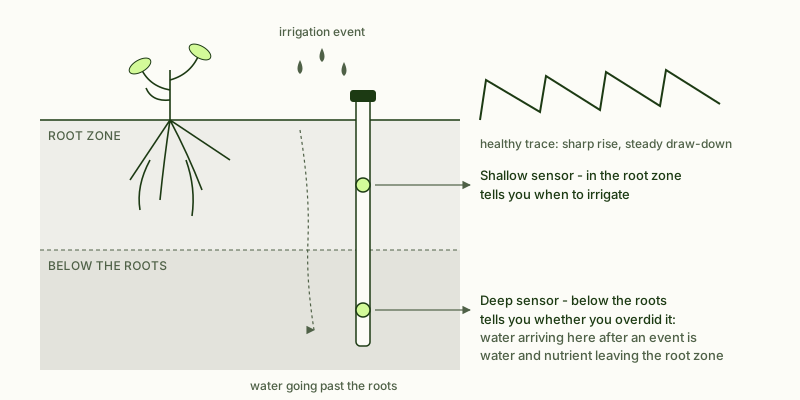
A healthy irrigated soil shows a sawtooth: a sharp rise when water arrives, then a steady decline as the crop draws it down, then the next rise. The slope of the decline is the crop’s water use, and it is the single most informative number the system produces - it tells you demand is rising as the canopy closes, and it tells you immediately when something has gone wrong, because a crop that stops drawing water has stopped growing.
Flat traces mean the sensor is not in the root zone or is not in contact with soil. Traces that never decline mean over-irrigation. Deep sensors that spike after every event mean water is going past the roots.
What it connects to
Moisture data is the input to irrigation automation, and it becomes considerably more useful alongside evapotranspiration figures from an on-site weather station, which let you forecast demand rather than only observe it. Both feed into the record-keeping side covered in farm management software.
Sensor types compared
Partner programmes for this category are not in place yet, so no product links are shown. The comparison below is editorial and based on sensor class rather than brand.
- 01
Capacitance / FDR probes
Sensor class
The default choice for continuous monitoring. Measures the dielectric constant of the soil, which tracks water content closely. Available as multi-depth profile probes that read a whole root zone from one installation.
Strengths
- Low power, suits battery and solar logging
- Multi-depth profile versions show where roots are actually drawing water
- Cheapest route to continuous data
Limitations
- Reading is soil-specific and needs calibration for accurate volumetric values
- Sensitive to air gaps left during installation
- Salinity affects the reading in fertigated soils
No partner link for this product yet - the comparison is editorial only.
- 02
Tensiometers
Sensor class
Measures the suction a plant must overcome to extract water, rather than how much water is present. Closer to what the plant experiences, and directly comparable across soil types.
Strengths
- Reads plant-available water, not just water content
- Needs no soil-specific calibration
- Well established in orchards and vineyards
Limitations
- Requires maintenance, the water column needs refilling
- Limited useful range, breaks contact in dry soil
- Less suited to fully automated installations
No partner link for this product yet - the comparison is editorial only.
- 03
TDR probes
Sensor class
Time-domain reflectometry, the reference method. Sends a pulse along a waveguide and measures its travel time, which depends on water content.
Strengths
- Most accurate, least soil-dependent of the electronic methods
- Largely unaffected by moderate salinity
- The method other sensors are validated against
Limitations
- Substantially more expensive per point
- Higher power draw complicates remote deployment
- Rarely justified outside research and high-value crops
No partner link for this product yet - the comparison is editorial only.
- 04
Gypsum blocks / granular matrix
Sensor class
Measures electrical resistance across a porous block that equilibrates with soil moisture. The low-cost tensiometer alternative.
Strengths
- Inexpensive, tolerates dry conditions well
- No maintenance during a season
- Adequate where the decision is simply irrigate or wait
Limitations
- Degrades and needs replacing, typically within a few seasons
- Poor resolution in wet soil
- Slow to respond to rapid changes
No partner link for this product yet - the comparison is editorial only.
Frequently asked questions
How many sensors does a field need?
Fewer than most vendors suggest and more than one. The standard approach is to identify management zones - areas that behave similarly in terms of soil type, slope and historic yield - and instrument each zone at two depths. For a uniform field that can mean a single station; for a variable one, three or four. Adding sensors within a zone adds cost without adding information.
What depth should sensors be installed at?
At least two depths, one in the active root zone and one below it. The shallow sensor tells you when to irrigate; the deep sensor tells you whether you overdid it. Water arriving at the deep sensor after an irrigation event is water and nutrient leaving the root zone, and that pairing is what turns a moisture reading into an actionable irrigation decision.
Do cheap sensors work?
For relative changes, often yes. Inexpensive capacitance probes track wetting and drying reliably enough to schedule irrigation, even when their absolute volumetric numbers are wrong. The failure comes when someone treats an uncalibrated absolute reading as truth and sets a threshold against it. Judge the trend, not the number, unless the probe has been calibrated in the soil it sits in.