VOA3R
Aquaponics and soilless growing
Coupled fish-and-plant systems, the water chemistry that decides whether they work, and an honest account of where straightforward hydroponics beats aquaponics.
Aquaponics is genuinely elegant: fish produce ammonia, bacteria convert it to nitrate, plants take up the nitrate and return cleaner water to the fish. Three biological systems in one loop, each solving a problem the others create.
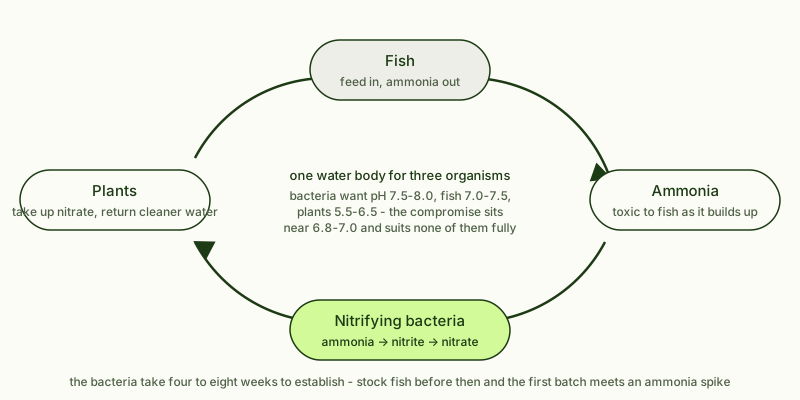
It is also frequently oversold, and the honest version is more useful than the enthusiastic one. Aquaponics asks you to keep three living systems healthy at once, with a single set of water parameters that suits none of them perfectly. It rewards attentive operators and punishes intermittent ones harder than either fish farming or hydroponics alone.
The compromise at the centre
Every design decision in aquaponics traces back to one fact: the three organisms want different water.
| Preferred pH | Preferred temperature | Most sensitive to | |
|---|---|---|---|
| Fish (warm-water species) | 7.0 - 7.5 | 24 - 28 °C | Ammonia, low oxygen |
| Nitrifying bacteria | 7.5 - 8.0 | 25 - 30 °C | Cold, low oxygen, chlorine |
| Plants | 5.5 - 6.5 | 18 - 24 °C | Micronutrient lockout |
Running at roughly pH 6.8 to 7.0 keeps everything alive and nothing optimal. The practical consequence is that iron, and often potassium and calcium, must be added rather than supplied by the fish. Anyone claiming a closed system needs no inputs beyond feed is describing a system that is quietly running a nutrient deficiency.
Choosing a starting point
If the goal is food for a household, a small media-bed system is the most forgiving design and the easiest to fix when something goes wrong. Starter systems covers what is worth buying assembled and what is better built.
If the goal is commercial leafy greens, decoupled systems - where fish water is treated and buffered before reaching the plants, rather than flowing straight through - have largely won the argument. They let each loop run near its own optimum and remove the compromise described above.
If the goal is only plants, use hydroponics. This is not a popular thing to say in aquaponics circles, but a grower who wants lettuce and does not want fish should not take on a fish farm to get fertiliser.
What to measure
Water testing is the whole discipline. Nutrient and water testing sets out the parameters, the sensible testing intervals and where cheap test kits mislead. The short version: ammonia and nitrite daily during cycling and after any change, nitrate and pH weekly once stable, and dissolved oxygen continuously if the stocking density is anything above ornamental.
Lighting is the other major equipment decision for indoor systems, and the one where marketing claims are least tethered to physics. Grow lights covers what the specifications mean and which numbers actually predict plant growth.
Related sections
The fish side of an aquaponic system is a small aquaculture operation with the same requirements as any other - see aquaculture technology, particularly water quality monitoring. For enclosed growing structures and their climate control, see greenhouse and vertical farming.
Frequently asked questions
Is aquaponics more productive than hydroponics?
For plants alone, no. Hydroponics with a formulated nutrient solution gives more precise control and generally higher and more consistent plant yields, because the grower sets every element independently. Aquaponics produces two crops from one water system and avoids buying most nutrients, but the nutrient profile is whatever the fish and bacteria happen to produce, which is usually short on potassium, iron and calcium.
How long does it take to start an aquaponic system?
Four to eight weeks before it can carry a meaningful load, because the nitrifying bacteria have to establish first. Cycling with an ammonia source before adding fish is the standard approach. Systems stocked immediately after filling almost always run into an ammonia or nitrite spike that kills or stunts the first batch of fish.
What pH should an aquaponic system run at?
Around 6.8 to 7.0, which is a compromise nobody is happy with. Nitrifying bacteria prefer roughly 7.5 to 8.0, most fish species are comfortable near 7.0 to 7.5, and plants take up micronutrients best between 5.5 and 6.5. The compromise costs some nutrient availability, which is why iron in particular usually has to be supplemented in chelated form.