Aquaculture
Recirculating aquaculture systems
Closed systems buy control over temperature, biosecurity and location, and pay for it with capital, energy and a much lower tolerance for operator error.
A recirculating aquaculture system treats and reuses its water rather than exchanging it. Typically well over 90 percent of the volume is recycled each day, with a small make-up flow replacing what is lost to backwash and evaporation.
What that buys is control. Temperature independent of season, biosecurity independent of the surrounding water body, effluent that is concentrated and manageable, and a site that can be near a market rather than near a river. What it costs is capital, continuous energy, and a system that will not forgive a weekend of inattention.
The chain and its weakest link
Water leaves the tank carrying solids, ammonia and carbon dioxide, and low in oxygen. It passes through mechanical filtration, biological filtration, degassing, oxygenation and often disinfection, then returns. Each stage depends on the one before it.
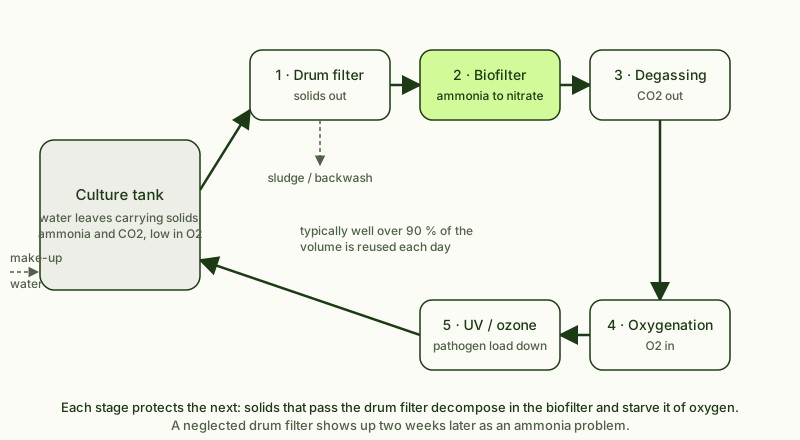
The dependency that matters is that mechanical filtration protects the biofilter. Solids that get through decompose in the biofilter, consuming the oxygen the nitrifying bacteria need and blinding the media surface. A drum filter that has been neglected does not announce itself as a drum filter problem - it announces itself two weeks later as an ammonia problem.
Alkalinity is the parameter that catches people out
Nitrification consumes alkalinity, and it consumes a substantial amount of it per unit of ammonia processed. In a closed system with limited water exchange there is nothing to replace it.
As alkalinity falls, pH stability goes with it. The system holds steady for a while and then moves quickly, because a low-alkalinity system has no buffering capacity left. When pH drops, nitrification slows, ammonia rises, and the operator sees what looks like a sudden biofilter failure.
The fix is routine bicarbonate addition, dosed against a measured alkalinity level rather than a schedule. It is cheap, it is boring, and skipping it is behind a large share of RAS problems.
What redundancy actually needs to cover
Three failures can empty a tank of stock within hours: loss of oxygen supply, loss of circulation, and loss of power. A serious system treats these as certainties rather than risks.
That means a generator that starts automatically and is tested under load, not just started monthly. It means backup oxygen with independent delivery - a liquid oxygen supply plus a separate bank of cylinders. It means a second circulation pump that can be brought online without tools. And it means the alarm path described in water quality monitoring, with at least one route that works when mains power and internet do not.
Related
Water quality instrumentation is the operational core of any closed system - see water quality monitoring. Where plants are used as part of the nutrient removal step rather than a separate treatment stage, the system becomes coupled aquaponics, covered in aquaponics and soilless growing.
The treatment train, component by component
Partner programmes for this category are not in place yet, so no product links are shown. The list below is the standard component sequence rather than a product ranking.
- 01
Mechanical filtration
Stage 1
Removes solid waste - uneaten feed and faeces - before it breaks down. Usually a rotating drum screen, sometimes a settling device on smaller systems.
Strengths
- Removes the largest share of the waste load cheaply
- Protects the biofilter from clogging and oxygen competition
- Simple, well proven technology
Limitations
- Needs continuous backwash water and regular servicing
- Screen failure rapidly overloads everything downstream
- Fine solids pass through and accumulate regardless
No partner link for this product yet - the comparison is editorial only.
- 02
Biological filtration
Stage 2
The living heart of the system. Nitrifying bacteria on a high-surface-area medium convert ammonia to nitrite and nitrite to nitrate.
Strengths
- The only practical way to handle ammonia in a closed system
- Stable and self-sustaining once mature
- Scales predictably with feed input
Limitations
- Takes four to eight weeks to establish
- Sensitive to cold, low oxygen and any antibacterial treatment
- Failure here is the classic total-loss scenario
No partner link for this product yet - the comparison is editorial only.
- 03
Degassing and aeration
Stage 3
Strips accumulated carbon dioxide, which otherwise suppresses pH and stresses fish, and restores dissolved oxygen.
Strengths
- Prevents the pH crash that follows CO2 accumulation
- Relatively cheap to add
- Often combined with oxygen injection in one stage
Limitations
- Continuous energy demand
- Requires ventilation of the building, not just the water
- Frequently undersized in first builds
No partner link for this product yet - the comparison is editorial only.
- 04
Oxygenation
Stage 4
Pure oxygen injection, usually through cones or low-head contactors. What allows stocking densities that aeration alone could never support.
Strengths
- Raises carrying capacity dramatically
- Precise control of dissolved oxygen
- Efficient transfer compared with air
Limitations
- Ongoing oxygen supply cost and a delivery dependency
- Requires backup, this is a single point of failure
- Adds complexity and safety requirements
No partner link for this product yet - the comparison is editorial only.
- 05
Disinfection
Stage 5
Ultraviolet or ozone treatment to reduce pathogen load in the recirculating flow.
Strengths
- Meaningfully reduces disease pressure
- UV is simple and predictable
- Supports the biosecurity case for RAS
Limitations
- Ozone is hazardous and needs careful control
- UV lamps lose output long before they fail visibly
- Does not compensate for poor husbandry
No partner link for this product yet - the comparison is editorial only.
Frequently asked questions
How long does it take to cycle a new RAS?
Four to eight weeks at normal operating temperature, and longer if the water is cold. Nitrifying bacteria are slow growers. The sequence is an ammonia rise, then a nitrite rise as the first population establishes, then both falling to near zero as the second does. Stocking before nitrite has cleared is the most common and most expensive beginner error.
Why do biofilters fail?
Almost always because they were starved, chilled, deoxygenated or medicated. A system left unfed during a gap between batches loses its bacterial population. Any antibacterial treatment added to the water treats the biofilter as well as the fish. And because nitrification consumes alkalinity, a system without alkalinity supplementation eventually drops in pH to the point where the bacteria slow down, which looks like a sudden ammonia problem but is actually a chemistry problem weeks in the making.
Is RAS profitable?
It can be, in a narrower set of circumstances than the sector's marketing suggests. It works where a price premium exists for local, year-round or certified production, where energy is affordable, and where the operator is genuinely skilled. The insolvencies in this sector have generally not been biological failures - they have been businesses whose production cost per kilogram never fell below the market price.