Aquaponics
Aquaponics starter systems
Media bed, deep water culture or nutrient film - the choice determines how forgiving the system is when something goes wrong, which matters more than yield at the start.
The first decision in aquaponics is the growing method, and it should be made on forgiveness rather than yield. A beginner system’s job is to survive the mistakes that will be made in it.
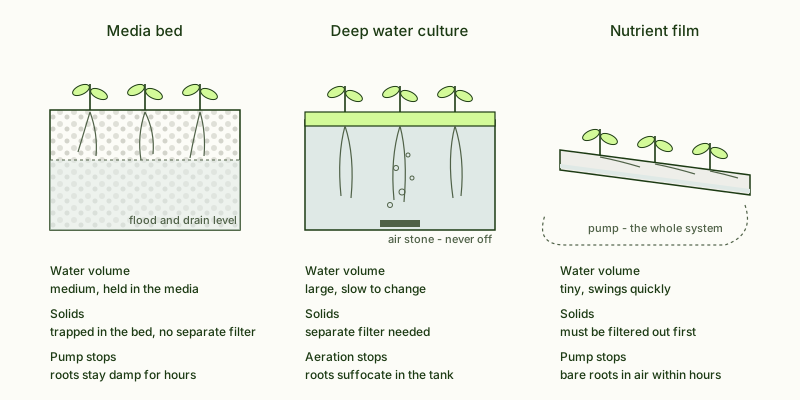
Choosing on failure tolerance
Media beds are the most forgiving design available. The medium holds water, hosts a large bacterial population, and traps solids so no separate filter is needed. If a pump stops, roots stay damp for hours. If dosing is wrong, the volume and biological mass buffer it. The costs are weight, lower planting density, and eventual clogging.
Deep water culture puts roots directly in a large aerated volume. That volume is itself a buffer - temperature and chemistry move slowly. But the roots depend on continuous aeration, and solids must be filtered out separately or they coat the roots.
Nutrient film is the least forgiving. The water volume is tiny, so temperature and chemistry swing quickly, and a pump failure exposes bare roots to air within hours. It is efficient and it is not a first system.
For a first build, a media bed. For a commercial leafy green operation, deep water culture with proper solids removal.
Cycling is not optional
A new system has no nitrifying bacteria. Adding fish before those bacteria exist produces the sequence that kills most first batches: ammonia accumulates because nothing converts it, then nitrite accumulates because the second bacterial population lags the first, and both are toxic.
Cycling means establishing that population before stocking, by adding an ammonia source and waiting. Ammonia rises and falls, then nitrite rises and falls, and when both read near zero while nitrate is present, the system is ready. This takes four to eight weeks and cannot be meaningfully hurried, though seeding with media from an established system helps.
The temptation to stock early is strong and it is the single most common way a first system fails.
What to buy rather than build
Most of an aquaponic system can be improvised from containers and plumbing fittings. Three components are worth spending on.
The air pump. Aeration failure kills fish faster than anything else. Buy a reliable one and keep a spare, plus a battery-backed unit if the stock has value.
The water pump. Continuous duty, submersible, sized with margin. Undersized pumps run hot and fail early, usually at the least convenient moment.
A test kit. A liquid reagent kit for ammonia, nitrite, nitrate and pH. Test strips are convenient and insufficiently accurate at the low ammonia and nitrite concentrations that matter, which is exactly where accuracy is needed. See nutrient and water testing.
The nutrients that will be missing
A system fed only by fish will run short of iron, and usually potassium and calcium as well. This is not a fault in the design, it is a consequence of fish feed containing what fish need rather than what plants need, compounded by the pH compromise described in the aquaponics overview.
Iron deficiency shows as yellowing between the veins of new leaves while the veins stay green, and it is corrected with chelated iron. Expect to supplement, and treat anyone claiming otherwise with caution.
The three growing methods
Partner programmes for this category are not in place yet, so no product links are shown. The comparison is by growing method.
- 01
Media bed
Growing method
Plants grow in an inert medium such as expanded clay or lava rock, flooded and drained on a cycle. The medium also hosts bacteria and traps solids.
Strengths
- Most forgiving, the medium buffers mistakes
- Handles solid waste without separate filtration
- Supports large fruiting plants as well as greens
Limitations
- Heavy, needs substantial structural support
- Medium clogs with solids over years
- Lowest plant density per unit area
No partner link for this product yet - the comparison is editorial only.
- 02
Deep water culture
Growing method
Plants float on rafts with roots suspended directly in aerated water. The commercial standard for leafy greens.
Strengths
- High density and fast growth for greens
- Large water volume buffers temperature and chemistry
- Easy to harvest and replant
Limitations
- Requires separate solids filtration
- Root aeration is critical and unforgiving
- Poor fit for large fruiting crops
No partner link for this product yet - the comparison is editorial only.
- 03
Nutrient film technique
Growing method
A thin film of water flows through channels past bare roots. Efficient and compact.
Strengths
- Minimal water volume and weight
- Efficient nutrient delivery
- Stacks and scales neatly
Limitations
- Very low tolerance for pump failure, roots dry within hours
- Needs thorough solids removal to avoid channel blockage
- Poor thermal buffering
No partner link for this product yet - the comparison is editorial only.
Frequently asked questions
What should a first system cost?
A small media-bed system built from a stock tank, a grow bed, a pump and an air pump is inexpensive and adequate for learning. Complete commercial kits cost several times more and mostly buy convenience and a tidier appearance. The component that is genuinely worth buying rather than improvising is the air pump - it is the part whose failure kills fish fastest.
How many fish for how many plants?
The common rule of thumb relates feed input to plant growing area rather than fish numbers to plant numbers, because it is the feed that supplies nutrients. Roughly speaking, a lightly stocked system supports leafy greens comfortably and struggles to supply fruiting crops, which need considerably more nutrient. Beginners almost always overstock fish and under-provide plants, which is the direction that causes water quality problems.
Can I use goldfish or ornamental fish?
Yes, and for a learning system it is a reasonable choice - they are hardy, tolerant of beginner errors, and the loss of one is not a financial event. They produce nutrients as effectively as edible species. The trade-off is that the system produces one crop instead of two.