Aquaculture
Pond aeration
Aeration is the most direct lever on carrying capacity most pond producers have. It is also the difference between a routine morning and finding the crop dead.
In pond aquaculture, aeration is usually what separates an extensive operation from an intensive one. It does not make fish grow. It removes the ceiling that oxygen would otherwise place on how many fish the pond can carry.
The daily oxygen cycle
A productive pond breathes. During daylight, algae photosynthesise and oxygen rises, often to well above saturation by late afternoon. After sunset photosynthesis stops but respiration does not, and oxygen falls steadily until dawn.
That trough is the operational reality of pond farming. Everything about aeration strategy follows from it: the minimum matters, the daily average does not, and the measurement that counts is taken in the dark.
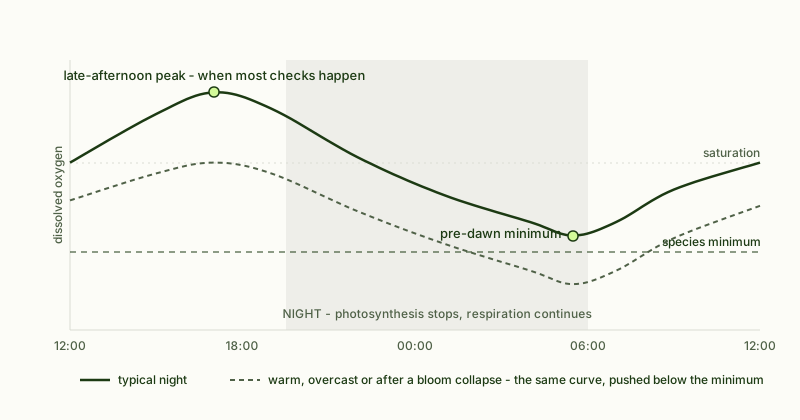
The pattern turns dangerous in three situations. After a hot, still day, because warm water holds less oxygen and there is no wind mixing. After several overcast days, because photosynthesis has been suppressed while respiration continued. And after an algal bloom collapses, which is the worst case - the oxygen producers become a large mass of decomposing organic matter consuming oxygen continuously, day and night.
Sizing against feed, not volume
The instinct is to size aeration against pond area or volume. The better predictor is feeding rate, because feed is what enters the system and everything that consumes oxygen downstream is proportional to it.
Fish respire in proportion to what they eat. Uneaten feed and faeces are broken down by bacteria that respire too. A pond fed heavily has a high oxygen demand regardless of its size, and a lightly fed pond of the same dimensions does not.
The practical method is empirical: instrument the pond, measure the pre-dawn minimum through the warm season at realistic feeding rates, and add capacity until that minimum sits with margin above the species threshold. Published stocking and aeration guidance from extension services provides a starting point, and much of it is openly available - see finding agricultural research.
Circulation matters as much as transfer
An aerator does two things: it puts oxygen into the water, and it moves the water. The second is easy to underrate.
Oxygen added at one end of a large still pond does not reach the other end. Worse, ponds stratify in warm weather, with a warm oxygenated upper layer sitting on cold, oxygen-depleted, sometimes sulphidic bottom water. Fish are confined to the upper layer, and if wind or a temperature change mixes the two abruptly, the bottom water’s oxygen demand is imposed on the whole pond at once.
Paddlewheels drive strong horizontal circulation, which is a large part of their enduring popularity. Diffused systems address stratification directly by lifting bottom water. Many operations run both, for different reasons.
Emergency capacity
Stock represents months of accumulated feed cost and cannot be replaced quickly. Emergency oxygen - cylinders and diffusers held in reserve - is cheap relative to that value and is the only intervention fast enough to matter during a crash.
It is only useful in combination with an alarm that reaches someone in time, which is the point made in water quality monitoring. Emergency equipment that nobody is woken to deploy is an expense, not a safeguard.
Aeration equipment types
Partner programmes for this category are not in place yet, so no product links are shown. The comparison is by equipment type.
- 01
Paddlewheel aerators
Equipment type
Surface aerators that throw water into the air while driving a horizontal current. The workhorse of pond aquaculture.
Strengths
- High oxygen transfer per unit of energy
- Creates circulation that moves water past the whole stock
- Robust and field-serviceable
Limitations
- Noisy, and unsuitable near housing
- Surface only, limited help in stratified deep ponds
- Moving parts in water, regular maintenance
No partner link for this product yet - the comparison is editorial only.
- 02
Diffused aeration
Equipment type
A shore-mounted blower feeds air through weighted tubing to diffusers on the pond floor. Bubbles aerate as they rise and lift bottom water.
Strengths
- Destratifies effectively, addresses the bottom layer directly
- No moving parts in the water
- Quiet, suits sites near neighbours
Limitations
- Lower transfer efficiency in shallow ponds
- Diffusers foul and need periodic cleaning
- Weaker horizontal circulation than paddlewheels
No partner link for this product yet - the comparison is editorial only.
- 03
Aspirator and injector aerators
Equipment type
Draw air into a submerged water stream, mixing fine bubbles into a directed flow. Good for targeted work.
Strengths
- Directs oxygenated water where it is needed
- Effective in deeper water than surface aerators reach
- Compact and easy to reposition
Limitations
- Moderate efficiency compared with paddlewheels
- Limited area of effect per unit
- Prone to intake blockage
No partner link for this product yet - the comparison is editorial only.
- 04
Emergency oxygen injection
Equipment type
Pure oxygen delivered through diffusers, held in reserve rather than run continuously.
Strengths
- The only thing that raises DO fast enough during a crash
- Independent of the electrical supply if cylinder-fed
- Cheap insurance relative to stock value
Limitations
- Operating cost too high for continuous use in ponds
- Requires cylinder handling and safe storage
- Useless if nobody is alerted in time
No partner link for this product yet - the comparison is editorial only.
Frequently asked questions
Why does dissolved oxygen crash just before dawn?
Because photosynthesis stops at sunset while respiration continues all night. In a productive pond the algae that generate oxygen all day become net consumers in darkness, alongside the fish and the bacteria breaking down organic matter. Oxygen therefore falls continuously through the night and reaches its minimum shortly before sunrise. The risk is highest after a hot still day, and highest of all after an algal bloom dies back.
How much aeration does a pond need?
It scales with feed input rather than water volume, because feed drives the entire oxygen demand chain - fish respiration, then bacterial breakdown of waste. Extension services publish horsepower-per-hectare guidance by species and intensity, but the more useful approach is to measure dissolved oxygen at dawn during the warmest part of the season and add capacity until the pre-dawn minimum sits comfortably above the species threshold.
Can aeration be run only at night?
That is normal practice and it is where most of the benefit lies, since the deficit is nocturnal. Many producers run from late evening until mid-morning. The caveat is that a hot still overcast day can produce a daytime deficit too, and a dying bloom can consume oxygen around the clock - which is why monitoring should not be switched off when the aerators are.