Greenhouse
Greenhouse climate control
Greenhouse control is transpiration control. Once that is the goal rather than temperature or humidity alone, most of the counter-intuitive equipment behaviour makes sense.
Greenhouse climate control looks like temperature management and is really transpiration management. Almost every apparently strange behaviour in a well-run house - heating with the vents open, closing screens on a bright day, running fans when the temperature is already correct - makes sense once transpiration is the target.
Why transpiration is the target
Water evaporating from leaves does two jobs. It cools the leaf, and it drives the flow of water and dissolved minerals from root to shoot.
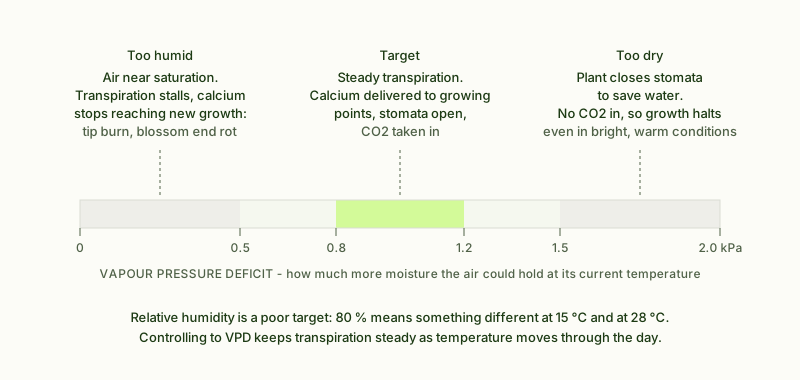
The second job is the one that causes trouble. Calcium moves almost exclusively in that transpiration stream, and it does not redistribute once deposited. A plant that stops transpiring stops delivering calcium to its newest tissue, and the newest tissue is precisely what needs it: growing points and developing fruit. That is the mechanism behind tip burn in lettuce and blossom end rot in tomatoes and peppers, both of which are usually climate faults rather than soil calcium deficiencies.
Too much transpiration is also a problem: the plant closes its stomata to avoid water loss, and closed stomata cannot admit carbon dioxide, so photosynthesis stops.
VPD, and why it replaced relative humidity
Relative humidity is a poor control variable because it changes with temperature even when the absolute moisture content does not. Air at 80 percent humidity means something quite different at 15 degrees than at 28.
Vapour pressure deficit expresses the same physics in a way the plant responds to: how much more moisture the air could hold at its current temperature. Controlling to a VPD target keeps transpiration steady as temperature moves through the day, which is what the crop needs.
Values around 0.8 to 1.2 kilopascals suit most crops in active growth. Propagation and rooting want lower; anything above roughly 1.5 begins to cost photosynthesis.
Screens are the boring recommendation that pays
In any climate with a real heating season, movable thermal screens are usually the fastest-returning greenhouse investment available. They cut radiative night-time heat loss substantially for a fraction of the cost of reglazing, and modern screens serve as daytime shading and as part of humidity strategy.
The complication is that a closed screen traps humidity beneath it, which is why screen control and dehumidification strategy have to be designed together rather than separately. A gap left in the screen, or a scheduled brief opening, is the usual answer.
Sequencing the limits
Plants are limited by whatever is scarcest. Adding more of something that is not limiting produces nothing, which is where a lot of greenhouse spending goes wrong.
The usual order is light, then temperature, then CO2, then water and nutrients. On a dull winter day at high latitude, light is limiting: enriching CO2 will not help, and neither will more heat beyond what prevents disease. On a bright day in a sealed house, CO2 becomes limiting quickly and enrichment pays well.
Knowing which limit is currently binding is more valuable than any individual piece of equipment, and it is why measurement - covered for the outdoor case in weather stations - matters as much under glass as outside it.
Related
Irrigation under cover is fertigation and shares its control logic with irrigation automation. The fully enclosed case, where light is supplied rather than admitted, is covered in vertical farming and grow lights.
Climate control equipment
Partner programmes for this category are not in place yet, so no product links are shown. The comparison is by equipment role.
- 01
Thermal and shade screens
Equipment role
Movable horizontal screens that retain heat at night and reduce radiation load by day.
Strengths
- Usually the shortest payback of any greenhouse upgrade
- Cuts night heat loss substantially
- Doubles as shading and humidity management
Limitations
- Trapped humidity beneath a closed screen needs managing
- Mechanism requires maintenance
- Reduces daytime light when deployed
No partner link for this product yet - the comparison is editorial only.
- 02
Ventilation - roof and side vents
Equipment role
Passive air exchange driven by temperature and wind. The primary humidity and temperature control in most structures.
Strengths
- No running cost once installed
- High capacity when sized properly
- Simple and reliable
Limitations
- Ineffective on still days
- Loses enriched CO2 immediately when opened
- Control needs to account for wind direction
No partner link for this product yet - the comparison is editorial only.
- 03
Heating systems
Equipment role
Pipe, air or radiant heating. Sets the minimum temperature and, critically, drives air movement and drying.
Strengths
- Enables production outside the natural season
- Pipe heating creates useful convection
- Prevents condensation on crop surfaces
Limitations
- The dominant operating cost in cool climates
- Fuel price exposure sits here
- Poorly zoned systems waste a large share
No partner link for this product yet - the comparison is editorial only.
- 04
CO2 enrichment
Equipment role
Raising carbon dioxide above ambient to lift photosynthetic rate in a closed house.
Strengths
- Well documented yield response in light-sufficient conditions
- Cheap if waste CO2 from heating is captured
- Effective in sealed winter conditions
Limitations
- Lost immediately when vents open
- Pointless when light, not CO2, is limiting
- Requires monitoring for worker safety
No partner link for this product yet - the comparison is editorial only.
Frequently asked questions
What VPD should I target?
For most crops, roughly 0.8 to 1.2 kilopascals during active growth. Below about 0.5 the air is too close to saturation, transpiration slows, and calcium transport to new growth suffers - which shows as tip burn and blossom end rot. Above roughly 1.5 the plant closes stomata to conserve water and stops taking up CO2, so growth halts even though conditions look bright and warm.
Why heat and ventilate at the same time?
Because the goal is dehumidification, not temperature. On a cool damp night, opening vents alone drops the temperature without removing much moisture, since cold outside air carries little. Heating while venting brings in cold dry air, warms it so it can hold more water, and exhausts it laden with moisture. It looks wasteful and it is the standard method for preventing condensation-driven disease.
Is CO2 enrichment worth it?
In a sealed house with adequate light, yes - the photosynthetic response is well established. In a house that vents frequently, the enriched air leaves with the vented air and the money goes with it. And when light is the limiting factor, which it is on dull winter days at high latitude, adding CO2 changes nothing. The sequence is light first, then temperature, then CO2.