Journal
Why losses happen before dawn
The most predictable hazard in pond aquaculture kills stock on a schedule. The defences are well understood and routinely under-specified.
There is a particular kind of aquaculture loss that follows an entirely predictable schedule. The pond looked fine at the evening check. By first light the fish are at the surface, and by the time anyone arrives the loss has happened.
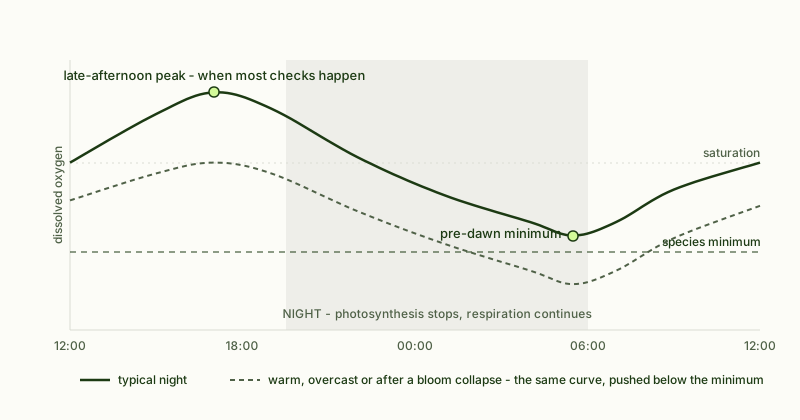
This is the pre-dawn oxygen minimum, and what makes it worth writing about is that it is not an unusual event. It is the normal daily behaviour of a productive pond, occasionally pushed slightly further than the stock can tolerate.
The mechanism
A pond with an algal population is an oxygen factory during daylight. Photosynthesis can drive dissolved oxygen well above saturation by late afternoon, which is when most casual checks happen and which produces a comfortable and misleading impression.
After sunset, photosynthesis stops. Respiration does not. The fish continue to respire, the bacteria decomposing organic matter continue to respire, and the algae themselves - net producers by day - become net consumers by night. Oxygen falls steadily through the hours of darkness and reaches its minimum shortly before sunrise.
Every night. The question is only how far it falls.
The three amplifiers
Heat. Warm water holds less dissolved oxygen, and warm fish consume more. A hot spell compresses the margin from both directions at once.
Cloud. Several overcast days suppress photosynthesis while respiration continues at full rate. The pond enters each night with less accumulated oxygen than usual, and the deficit compounds across consecutive dull days.
Bloom collapse. The dangerous one. A dense algal bloom that dies - after a hot still spell, a nutrient shift, or a treatment - converts the pond’s main oxygen source into a large mass of decomposing organic matter that consumes oxygen continuously, day and night. Oxygen demand rises sharply at exactly the moment supply disappears. Losses following a bloom collapse are typically the largest in pond aquaculture.
Why the defences fail
The technology to prevent this has existed for decades and is not expensive relative to the value of the stock. Losses continue, and the reasons are consistent.
Monitoring stops at the wrong time. Spot checks happen during working hours. The hazard is nocturnal. A pond checked at six in the evening and eight in the morning is unmonitored across the entire period in which the problem develops and resolves.
The alarm shares a dependency with the failure. A monitor on mains power alerting over site broadband cannot report a power cut, and a power cut stops the aerators. The alarm path must be independent of the thing most likely to go wrong.
Aeration is sized for the average. Aeration capacity is often calculated against typical conditions rather than the worst night of the season combined with the heaviest feeding rate. The margin that matters is the one available on the night everything coincides.
Emergency oxygen exists but nobody is woken. Cylinders and diffusers held in reserve are the only intervention fast enough to arrest a crash, and they are useless without someone alerted in time to deploy them. The equipment is frequently present; the alerting is frequently not.
What adequate looks like
Continuous dissolved oxygen monitoring with logging, so the nightly minimum is a known number rather than an assumption. Two alarm thresholds, a warning and a critical, with the warning set to give real response time. At least one alarm path with independent power and a cellular route. Aeration sized against the worst plausible night, not the typical one. Emergency oxygen on site. And the whole chain tested monthly, by pulling a probe into air and confirming that the message reaches the phone of the person actually on call.
None of this is novel and none of it is expensive against the value of a season’s stock. It is under-specified because the failure is intermittent, and because a pond that has been fine for three years reads as a pond that will be fine. The mechanism described above says otherwise: it is running every night, and the margin is narrower on some nights than on others.
The detail on sizing and equipment is in pond aeration, and on instrumentation in water quality monitoring.
Frequently asked questions
What is the single most common design failure in oxygen monitoring?
An alarm chain that shares a dependency with the failure it is meant to detect. A monitoring system running on mains power, alerting over site broadband, cannot warn about a power cut - which is one of the main causes of oxygen failure. At least one alarm route needs its own power and its own communication path.